Monday, April 17, 2017

AFRO PUNK

BY BLAKE PERRY


            I am at a loss. Hemp lollipops and unbearable sun. This day would seem unbearable to the people enjoying it if it was ten years ago before they had stumbled upon their ‘true selves’ on social media and learned to worship the sun god that my ancestors did. Pineapples being consumed as if it were a symbol of their connection with the earth that has rejected them here. Outfits meant to offend the eye under the guise of political profundity but only speak of conspicuous consumption. Who are these clowns in this clown house? A room of smoke and mirrors that will not allow me to find an Archimedean point so that I may stand and make a judgment of this distortion. We lack this point because the generation that inhabits the present has allied within themselves against themselves a treaty that prohibits the use of reason while reasoning. Cryptic because it is not meant to be understood, because understanding is the opening of revelation to the fact that we are dealing with myths.

            Marcus Garvey paintings that betray their very subject because the man painted would not have enjoyed becoming a commodity and being sold. Who are the consumers? Young black professionals, who only so recently embraced their blackness, since their environments and private schools that spawned them did not allow them to think such a thing. Young blacks who ten years ago would not be caught in such a black borough because it yields no conversation at home. The home that has been designed primarily to imitate those that have destroyed their homes. No. Family is a European concept, but in order to appropriate and parade around one’s supposed intellect, one must take on an economic understanding that is exclusively found in the European industrial revolution. Thus making themselves inherently unlike themselves. Let us examine the appropriation and mythologizing of figures such as Marcus Garvey.


            The sound pattern, the message, or the signifier of Marcus Garvey was that without knowledge of ourselves, we are like a tree without roots. The message signified that knowledge is power and when we understand our history, we become active. The sign for this message could be seen as the very continent of Africa, which is a representation of the Pan-African philosophy advocated for. Pan-Africanism is the recognition of the separation of many black people from their ancestors across the continent due to the diaspora. Marcus Garvey spoke of repatriation to Africa because he saw no hope in a country that was committed to black subordination. He suggested that black Americans found their own businesses in hopes of gathering money in order to complete the project. But this all becomes hollow for another purpose in this generation.


            The printing of Garvey on tee shirts at Afro Punk is a kind of metalanguage. As Barthes has stated in the study of myths, the myth relies upon language that is already there and thus is not creating any new material. Rather the purpose of the mythologist is to distort the message. The tee shirt is ripping Garvey out his context while ripping off his philosophy. The selling of these shirts is not for the possibility of repatriation. But to have a gaze fixed upon you. It is a status symbol of one’s liberation at the most superficial level. To be more provocative, this shirt is a conversation starter. It is the attempt to have three audiences. The first audience is those who frequent the same locations where we may find these shirts (the insiders). The insiders provide a measuring stick on which they may measure themselves on the longitudinal development of consciousness. The relation is not to be an uplifting one, but a competitive one. They attempt to out due one another by garnishing themselves with collected symbols (Pan- African colored pants, Garvey shirt, and a Egyptian symbol as a necklace).


            The next audience is of the same community (black), but of fewer resources (the outsider). This group consists of those who might be invested in the liberation movement but do not have the means or the desire to display it for transient observers. The insiders use this as an opportunity to test their ability to educate, or to do what they think education is actually supposed to do, shame. The shame comes from the inability of one to keep up with the endless creation of myths from a pseudointellectual and pseudohistorical motivation. The outsiders are the people the insiders use their confused vocabulary on. The blend a mixture of fact and bullshit in order to make a deadly combination that cannot be separated under the tool that allowed them to put it together (faulty reasoning). But they prowl around for the opportunity to use their faulty reasoning on the outsiders and speak quickly and incoherently in order to place the blame on the unreceptive (or just critical) receiver. The outsiders thus become the people who are not down with the struggle. The relation of the insider to the insider and the insider to the outsider reveal a characteristic that is inherently unlike the movement (distortion). It depends upon the same educational structure that Garvey was attempting to alleviate us from. An educational system that bases one’s success upon physical demarcations of success is of a Protestant work ethic (imported and European).


            The last audience is white America. The use of symbols is a kind of imaginary revenge that the insiders hope to inflict upon white America. It is the act of begging to be seen but unseen. That is, the insiders wish to demonstrate to this group that they are aware of the unforgiveable enslavement and falsification of history. All this can be communicated without the myths, but that would require the very effort that Garvey desired and that they are committed to not allow to be realized. Why not allow it to work? It is not allowed to work because to do so would to require more of the superficial use of myth through consumer symbols. It would require, as Baldwin and Diop would say, a confidence and resilience in oneself to compose of every work that we do with the utmost exertion. To them this is unthinkable because their end game is actually the very thing they wish to attack white America for, profit. Nietzsche once said that virtue without an observer is unthinkable to a nation of actors. The effort of understanding is unthinkable to a nation that has no audience. The system they have constructed is about stratification (the very thing we were subjected to). And their intentions are made obvious on Monday through Friday when they hurry to their professional jobs to generate and somewhat collect the white man’s loot that they will spend on showing their resentment.

            The man who inaugurated the Harlem Renaissance is brandished on a black tee shirt. His face is of the seriousness that he was speaking decades ago. Now, however, something is missing. ‘A quote? Another person? No no, another color!’ Or possibly a historical understanding. The image of Marcus Garvey has been emptied of its historical context.

            Why ask them to explain what they are or what they are doing? This pseudointellectual movement based upon appearances has an alibi in appearances and, therefore, to ask for an explanation of their contradictions is to attack our ancestors. Or even worse, to ask them to use the very tool that has been distorted and used against them, reason.


Sunday, April 16, 2017

Trump, Cthulhu, & the Chaos Star

By Nicolette Preradovic


            It’s January 20th, 2017. Donald Trump just got sworn into office and became the 45th President of the United States of America. I’m watching the inauguration LIVE on my Smart TV and making innocuous seven word statements on Facebook regarding this ironically satirical historic event, when an image pops up in my news feed. The image is a surrealist painting of Donald Trump symbolized as a giant Kraken, comfortably nesting on top of the White House. Seven giant brownish-orange tentacles expand outwards in every direction, coiling themselves around various objects, instruments, and characters. Like the octopus, the kraken is typically known to have eight tentacles, however, the image only displays seven- one tentacle is left out. (I imagine that it hides in the background, behind the White House, possibly symbolizing Trump’s private life, underhand dealings, or secret meetings.) There is a giant cloud of smoke rolling in from the upper left hand corner. It starts off a dark charcoal color then fades into a pale grey, just before hitting the clear blue sky on the right, then fades into the colors of a setting sun. Trump’s head is giant, and his yellow toupee sits on top of his head like a banana peel. (Which I would advise the citizens of America not to slip on.)


            The first tentacle (starting clockwise from Trump’s ginormous head) comes up from behind the White House. It coils up into the air, propping a vanity mirror in front of Trump’s smug expression. As he looks into his reflection, eyebrows raised, you get the sense that he is pleased with himself, even though the gaze of his eyes suspiciously suggest otherwise. The second tentacle sticks up mid-air into the blue sky, holding a smart phone with the twitter home page displayed on the screen: a bird, outlined in white, appears ready to take flight. The third tentacle wraps its midriff around the Capitol Hill building while extending the tip of its coil around a baby’s bottle, holding it tight. A different perspective emerges between the fourth and fifth tentacle. Two lines of characters form as they enter the White House from the concrete sidewalk. Vanishing into the unknown black hole of a door, we have a member of the KKK, a man wearing a black cloak, a soldier with a gold bullet for a head, a Soviet army commander, an oil (man?), a clown playing the accordion and laughing as a dollar flies around close by, and in the other line a row of greedy business men with the crooked hog as the caboose, giving us the thumbs up while smoking a cigar in his top hat. Instead of coiling around the characters, the tentacles are ushering the characters in with a guiding embrace. To the left of our central focus, is the Supreme Court, being wrapped by Krak’s sixth tentacle while the seventh tentacle holds on to three nuclear missiles, midair, against the giant puff of smoke.

            All of these images are relevant to what I will be discussing. Because decoding each and every image in the painting will take up too much time, I’ve decided to stick with a more abstract and broadened symbol here. One which has evolved over the decades and has developed its own metalanguage of associations, and has proven itself to envelope all of these different dynamic signifiers into one coherent mode of activity: the symbol of the chaos star. I say “activity” because it is a symbol that represents action, as opposed to signifying a story or concept. Now, I know what you must be thinking! How did I get the chaos star out of this particular image which is nothing but metaphorical political satire encompassed into a single painting? In the book “Mythologies,” Barthes explains to us that myth always comes under the heading of metalanguage: the depolitization which it carries out often supervenes against a background which is already naturalized, depoliticized by a general metalanguage, which is trained to celebrate things and no longer “act them.” (256) We can say that the painting is an artistic response that uses one set of symbols or “metalanguage” as a means of explaining Trump’s presidency, which does in fact appear to be a “celebration” of some old mythological ideal (Christianity?...particularly “white”). Or, we can go further into the depths of the mythological layering taking place here and examine how mythology has unfolded over time in order to bring us to this bombastic moment! I chose the latter. The following essay is a process of “UN-masking” or “UN-layering.”


            Mark Bryan, the artist of the painting, made a very clear statement on his art web page that the mythical image he used was that of a kraken, and not an octopus. His exact words are, “I had reservations about using an octopus like image because they really are amazing intelligent beings. I apologize to them everywhere.” This statement works really well in exposing the ways which these mythical layers have piled themselves on in our culture over the years. The kraken has not been used much as a significant emblem of cultural symbolism and does not display the norms, especially in the world of trend setters. There was the Kraken Black Spiced Rum that came out a while back, which looks cool on the shelves of liquor stores and displayed on glass shelves at the local bar, but I don’t actually know anyone who drinks it on a regular basis, (unless we want to conclude that Trump is the main consumer of this mythology!) – The fact that Bryan uses the kraken as Trump’s signifier over the octopus is a sign of his contention. “A mythological sea monster of Norwegian lore” derived from the word krake, signifying an animal that is twisted or unhealthy; crooked: these are the words on Mark Bryan’s page. An octopus, however- now that is a creature which has reached its glory during the Obama years of cultural appropriation. How ironic that it is a symbol of diversity, variability, mystery, vision, insight… camouflage. The octopus was everywhere! Kids from my generation (and younger) were getting octopus tattoos and there was octopus jewelry in every store: from Target to Hot Topic to Forever 21; a major fashion icon it was. But where did it come from? How did it get here? Both of the answers to these questions come from a very dark, very recluse, very mystical and magical world known as the Cthulhu Mythos. Yes, of course, the octopus is a very real animal, ever elusive and mysterious in its own right, and it’s not like these octopus trends weren’t accompanied by other “mysterious” animals, like the owl or cat. But that’s not what we’re going to be talking about here. We will only be looking at culture as a manifestation and layering of previous culture, through art and literature, not wildlife. For wildlife is a code that can never be cracked; humans are only but simulations of that life. Which explains why writers and artists are so haunted by it. Let’s take H.P. Lovecraft for instance, and the Cthulhu Mythos.


            H.P. Lovecraft’s rise to popularity was quick and sudden. I don’t mean quick in the sense that it happened overnight, but like most great writers, he didn’t reach his fame till long after he was dead. Once that happened, he soared! Lovecraft emerged from the world of being a cult fiction figurehead to being known as the “Master of Horror.” One of the major stories that brought him to fame was “The Call of Cthulhu,” which is about a giant octopus-man monster that rises from the depths of the ocean to terrorize earth. It’s been noted that Lovecraft was inspired by a sonnet written by Alfred Tennyson in 1830 called, “The Kraken,” – so the myth relates. However, it wasn’t until 2004 that a book was released by Phil Hines (a man known for his work in the field of chaos magick) that began to tie together the Cthulhu Mythos with the Chaos Star. The book was called “The Pseudonomicon” and explains in approximately 80 pages how you can get closer to “The Old Ones” (Cthulhu Mythos) and use the monster of madness (Cthulhu) as a symbol for a chaotic God, who is endlessly available to you in your path working chaote (a chaos magician) adventures. A web of significations indeed, and all interchangeably related. So much so, that the Cthulhu Mythos has its own metalanguage and provides an explanation of every single monster and dark entity imagined by Lovecraft. It is a mythological system developed by Lovecraft fans for Lovecraft fans. Cthulhu isn’t going anywhere! Some of the funniest political satire I ever read during the Presidential Campaign was printed on black t-shirts saying “Cthulhu for President: Why Choose the Lesser Evil?” It’s no doubt that the great monster octopus-man Cthulhu has made his way from the underground culture of cult fiction into the mainstream, but the pace at which this mythological entity is procreating its significations is astounding.


            Now, I want to get into the nitty gritty of the origins of the chaos star. Its origins stems from a man named Michael Moorcock, when he wrote, “The Eternal Champion,” in the 1970’s. “The Eternal Champion” is a story about a hero, ErekosĂ«, who is incarnated into a multiverse system for the purpose of saving the human race from the evils of the world, a completely different idea representing the 8-pointed star from our visions of it thus far. The symbol in the Moorcock series represents chaos and order, or “law,” and one of hero’s missions is to restore balance in the multiverse system. Restoring balance in this sense means not allowing chaos to overpower the law or the law to overpower chaos. Though, what “law” is he referring to here? Aleister Crowley, who wrote “The Book of the Law,” in 1904, describes this 8-pointed star or the “law” as “energy” that scatters at “high velocity,” perhaps we can than say that the “law” is the energy and the “chaos” is the scattering of that energy. Peter J. Carroll, who wrote “Liber Null” and “Psychonaut” in the 1980’s describes the chaos star as “psychological anarchy […] The aim is to produce inspiration and enlightenment through disordering our belief structure.” And, in fact, that is exactly what chaos magick does. It holds the idea that belief is a tool and used liberally and extremely individualistically. Each chaos magician holds within them their own variations of inspiration and belief, feeling free to use whatever god/entity/spirit suits their needs in the moment, and then discarding it when it no longer produces results. It is a dismantling of ordered belief systems so you can create new ones. The 8 arrows pointing in all directions from the star is an active statement of possibility, creativity, and shifting paradigms. This is why the hero, ErekosĂ«, is able to have multiple identities and can actively move through the layers of the multiverse system to accomplish his goals, even if those goals are eternal.


            Cthulhu, ErekosĂ«, the chaos star, the octopus, and the kraken, are all interchangeably members of a metalanguage that have one thing in common: they all pose as symbols for the signification of action. They traverse all functioning systems of cultural appropriation because they work and “act” in multidimensional realms of persuasion. Their symbolism catches on, it clings to their surroundings much like an emotional vampire and pulls those who are vulnerable into their web of significations. The one who uses the chaos symbol is the creator and the one who manifests other mythological symbols and their significations. What we see today with the Trump Presidency is a “celebration” of this action. One which was inevitable due to all the years Trump spent studying our culture long before he hit the campaign trail. The uneasiness the masses feel with Trump as President has as much to do with his open rhetoric against the mob as it has to do with the mob’s inability to reflect on itself. The lack of awareness that the image they present is the same image they get back through Trump’s tweets. There is most definitely a background mythological system at work here, the All-American White Christian rhetoric, the question is, which mask does Trump wear? That of the Chaos Magician or the White Christian? And if they are interchangeable, (as the chaos star presents), how can we use this symbol to restore balance in our malfunctioning nation?


Friday, April 14, 2017

GUNS

By Kristen Vosberg


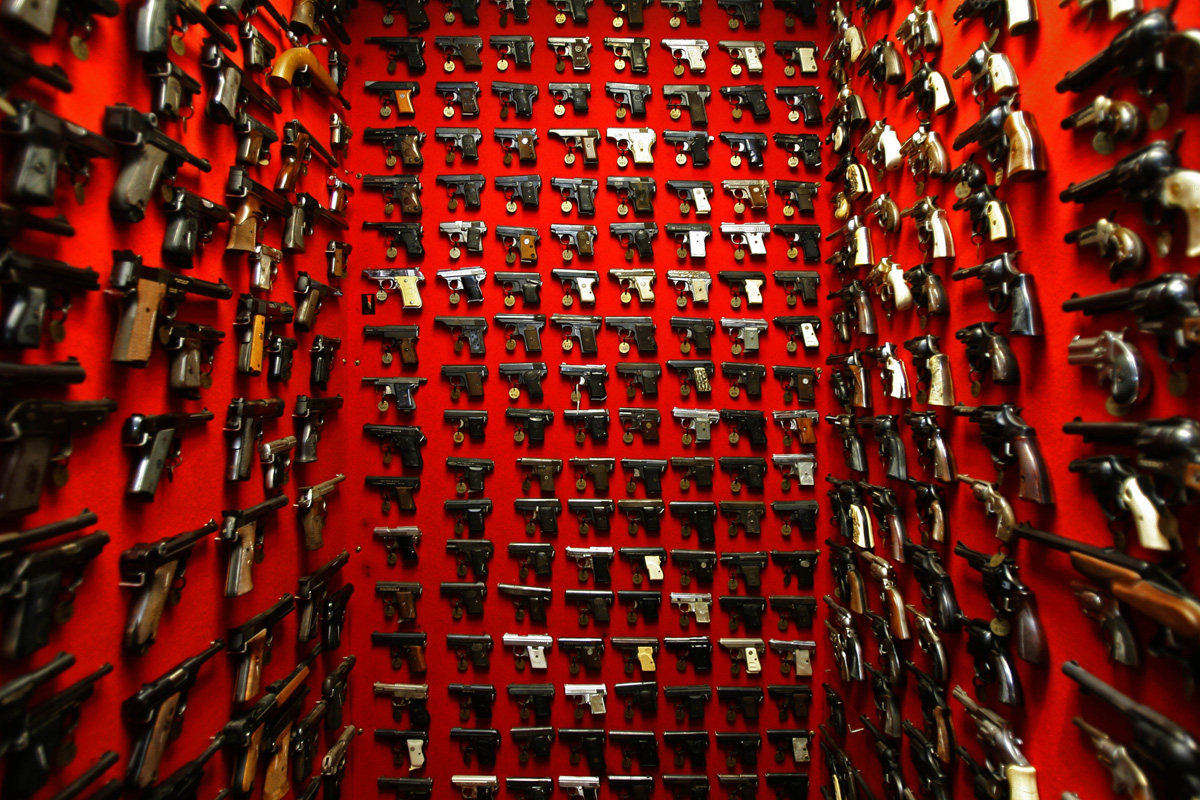
The gun has become enveloped in mythology as popular culture mediums reinforce its appropriation into myth. It is man’s tendency to regard the gun as a totem object, attaching to it gravid symbolism and exclamation that the public do take to be true. Their historical correspondences involve victorious, noble triumphs in which good taunts evil with its holy steel equalizer. Able to give historical intention a natural justification, internal taxpayers are often immobilized into believing the language of the gun is contained within innocent speech, as this language is naturalized through its prominent and positive position within historical dialogue. Popular media is successful in deriving a myriad of secondary signifiers, with the fire finger always serving as the primary. Discussing the integrated signified as well as historical and modern language of the gun is most conclusive when considering the linguistic mechanisms used to achieve its figment. This approach to analysis will serve dutifully the agenda of de-mythologizing.

Guns act explicitly as weapons capable of taking human life, and have existed under this function since their beginnings. To deny a pistol’s malicious morphology would be to deny that its handle displays grip notches into which one’s hand can slip comfortably, alleviated of some discomfort found in the white-knuckle grip. Indeed the gun’s skeleton has nestled into the innards of history as a critical extension of man’s guiding hand. Guns in history have been highlighted in educational texts and national media as necessary for countering danger and restoring morality amongst the composition of a people. History employs guns as a signifier to the signified, dignity. Truly also death, but death lies looking up at the overtones of honor and legality. American history shoots to evoke dialogue and attitudes associated with essentials such as patriotism, defense, and sympathy in guns. Under the mythology induced by gun history, a gun’s prescience can communicate insurance, martyr, salvation, and strength. Adversely, guns in the grasp of a chap who has been historically condemned to a status of potentially misguided, this conviction based on historical opposition, evokes opposite speech amongst the bourgeois. What’s signified changes under special conditions, which is characteristic of a myth and uncharacteristic of truth. Most of all, the gun’s role in both noble and malicious history makes the contingency of the standardized, stock situations under which it is employed appear eternal. The justification of the guns use via its history of overconsumption and overemployment deems it myth.


In a modern setting, guns permeate the media and the public consciousness with their expansive fabrication and limelight. Guns as a functional noun exercise the right to kill, and thus embody power and influence. Movies like Reservoir Dogs and Deer Hunter display the gun’s signifier of power, while comedian of questionable merit Sam Hyde exaggerates gun as a signifier for masculinity. Dirty Harry blatantly sexualizes it and Hip Hop musicians suggest “hands up, do or die, he got heat, no surprise.” Guns permeate our culture even though they are an object of innate destruction. The many appropriation aspects of the gun employ the display of power. It is exclaimed in the last example, MF Doom’s The Finest, that this confrontation now involves heat, the hot seat, pressure, and whatever’s going down will go down according to the beholder of the heat. The coined term ‘heat’ references again the distinct signifier of the gun’s morphology. Its explosive capabilities make the heat not merely an object but rather a hip-riding comrade one mobilizes for emotional support. The gun can be very comforting to stroke and experience, the power that history has invested in it communicates great certainty in the outcome for cats on both ends. Thus, fabrication of it is extensive and comprehensive. Whether their power is just or unjust, the associations made with guns are false, and can be best brought home by the echoed idiom “guns don’t kill people, people kill people.” The visual of a gun will literally dictate the trajectory of any situation due to the weight assigned to it by history and the congruent immobilizing significations employed by the modern media.

Guns have a history and geography, and places where their signification is not welcome.

It’s easy to make people feel weird when you talk about guns. You can try it. It’s completely fun. An apt example exists in my experience. When I told my brother and our friends that yes, I was going to college, they would often saunter up to me mumbling “better watch out, me and my gal are going to ruin your college experience.” They flash a toy gun. Weird shit! To anyone else this engagement would have maybe shaken them up for a full day, even justified some sort of restraining order-type action. If this is agreed upon by all of us, then it becomes clear that the algebraic value of the gun is considerable, and can act in place of language. Guns are a type of speech, as is true of Barthesian myth.


Guns are inflicted with the ailment of Icon. Having come to represent comprehensive notions of power and seduction, gun speech mongers emotion and allows for powerful and lucid communication to be exchanged even in the absence of words. Many unadjusted perspectives suggest that the continual ignorance of this mythologized language sustains problematic cognitive outcomes.


Thursday, April 13, 2017

WELLS FARGO

By Ian Vlahakis


            Wells Fargo & Co. is an American international financial services company. The company headquarters is located in San Francisco, California.

            The advertisement features a Latin-American man traveling across a quintessentially “American” landscape. The man’s profession is free-lance trucking. He drives past rolling green licked hills, stands at the edges of sweeping canyons, careens through the American interstate system, and stands adjacent to powerfully spinning wind turbines. The imagery evokes the motion and splendor of being “on the road” in America. His productive wayfaring is within the canon of American rootlessness. The nationalized pastime of road tripping. The color of the man’s truck is red with a blank white trailer, and when the truck is set against a blue vacant sky there is an orgy of patriotic color. He even passes a ranch with two cowboy looking men on horseback who are trotting around an enclosure. During the man’s travels he stops, from time to time, to pick up the sturdy-bony texture of certain stones. Each rock represents a place he has traveled. He writes the initial of the state on the stone’s surface. The narrative of the commercial shows the man is saving these rocks for his daughter. When the Latin-American man returns home, to his equally Latin-American daughter, he presents these stones as souvenirs of his travels. And then the patient, conspicuously maternal, voice of the spokeswoman reads a few lines of copy: “You work hard for more than just you. Working together we’ll help you save for her future geology degree.” These words are followed by the tag line, “Together we’ll go far.” This moment is followed by Wells Fargo’s brand image—the horse drawn stagecoach. The stagecoach glides across the rugged American plains.

            The narrative of the commercial acts as a tender vehicle for communicating what Wells Fargo is all about—planning for future security. The wandering journey of the man shows him literally going places. Those images act as a metaphor for his daughter’s eventual going places—her geology degree. The viewer understands that the father literally goes far so that his daughter will metaphorically go far in life. This story, of father and daughter, works hard to show Wells Fargo’s investment in these character’s lives, without even showing a bank. This leads to the first charge leveled at this commercial—“The Privation of History.”

            This commercial manages to sell a bank without showing, or even referencing a bank. There are no long lines to the teller to stand in. There are no glossily smiling websites to be interacted with. There are no ATM’s to plastically penetrate.

            In addition, this commercial elegantly sidesteps the recent scandal that plagued Wells Fargo. CNN Money reported in September of 2016, “federal regulators said Wells Fargo employees secretly created millions of unauthorized bank and credit card accounts—without their customers knowing it—since 2011. The phony accounts earned the bank unwarranted fees and allowed Wells Fargo employees to boost their sales figures…” Wells Fargo, in an effort to boost sales figure, created false accounts for real costumers. The accounts came with a whole slew of fees. This commercial makes no reference or nod to their mismanaging of public trust, but insists that they are invested in the futures of their customers.

            The more insidious privation of history comes in the condescending attitude the commercial takes toward Latin-Americans. The rough, hardworking protagonist is searching for stability and weight in this American landscape. The stones provide a good metaphor. He is searching to be tied down to something. This tether is his daughter who will one day seek her place in American cultural heroics. Many of these notions resonate with the iconic “American Dream” and other nationalized fictions. The narrative depicts the man traveling to Colorado, Arizona, and Wyoming (the initials are listed on the rocks). All three states are formerly part of Mexico. The Treaty of Guadalupe Hidalgo ceded this land to the United States Federation in 1848. The land ceded also included California, where Wells Fargo is based. The image that represents Wells Fargo as a brand is the stage coach. The stage coach that comes at the close of the commercial is diabolical. The scene directly evokes Manifest Destiny: the Manifest Destiney that redrew the border and took sovereign land from Mexico. The commercial insists on granting an urgent place for the rootless Latin-American family in America, while the ad simultaneously, if unconsciously, promotes ideas concerning manifest destiny, the chapter in American history that evicted all Mexican claim to place in America. The stagecoach is the most flagrant image of this paradox, but the commercial’s philosophy is also malignant with manifest destiny. The hard work and will power of the father ought to prevail. His work ethic will rear the dream of his daughter’s future. Wells Fargo is merely the security. 

            The use of a Latin-American father daughter combo is timely. Our recent political situation is rapidly moving to entrench the border between the U.S. and Latin-America. Current policy initiatives are working to amplify the power of border patrols, and to deport undocumented Latinos at record rates. The future for Latin-Americans in the United States is bleak, and yet, who will people turn to in this unsettling time—Wells Fargo. Wells Fargo will further assimilate the outsider into “Americanness,” and they, as a banking company, are working to inaugurate your future generations into the American educational caste system. The man’s daughter will have the means, if he saves his earnings, to go pursue a geology degree. It’s a classic immigrant story. The first generation works hard, saves, and invests in their children’s upward mobility. Wells Fargo stands with you. This commercial attempts to inoculate the viewer to the insidious political climate for Latin-Americans. The use of the Latin family, and their heart-string tugging story, shows anything is still possible in this America. The narrative can also be interpreted to exploit the latent fears and worries of not being American-enough. The bank shows a representational narrative of the hard-working Latin-man. They deprive a complex history in order to show the man’s ability to assimilate to American petit-bourgeois values. This petit-bourgeois value is the emphasis the American middle class places on education. The unquestioned value of a geological degree in today’s economic climate shows an inclination toward following one’s passions. This idea of pursuing one’s passion is dripping with petit-bourgeois judgment.

            The tag line, “Together we’ll go far,” sums up the Wells Fargo brand ethos. The father traveling far. His daughter rising through the American caste system. The stagecoach. All are related to motion, both, metaphoric and literal. The line is aphoristic and proverbial. This statement caps the commercial and seals any further interrogation of the ad’s narrative. The line is self-complete. Wells Fargo will take you places as these words suggest. The bank is a vehicle to prosperous Americanness. The commercial humanizes the granite-cock bank.